Why Cropped Leggings and Ankle Boots Fight Each Other Every Autumn
Quick Answer: Cropped leggings end at or just above the ankle bone; ankle boots start at or just above the same point. When two hems compete for the same two centimetres of ankle, you get either a gap of bare skin, a bunched overlap, or a horizontal break at the narrowest part of the leg. The reliable solutions are full-length leggings that tuck cleanly into the boot, or a deliberate gap of at least four centimetres — anything in between reads as an accident.
The leggings are your favourite pair. The boots are your favourite boots.
Together they produce a weird little bunch of fabric at the ankle and a leg line that stops short.
This is a geometry problem, and it has exactly two solutions.

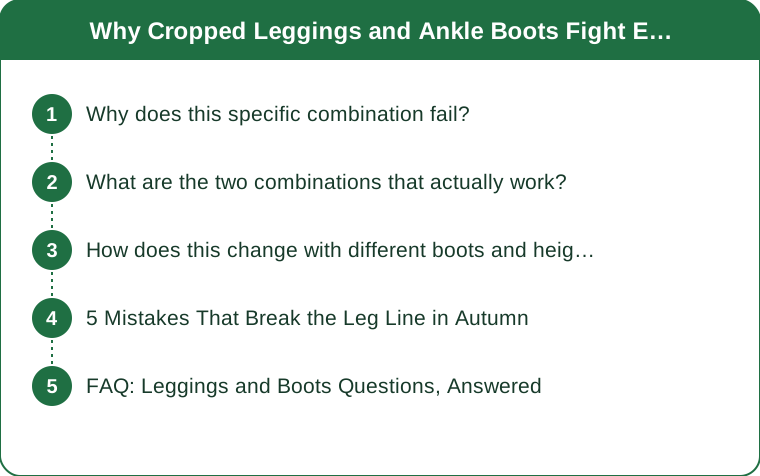
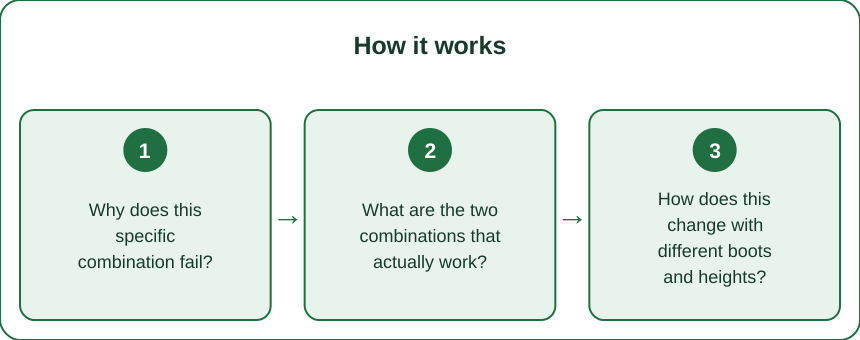
Why does this specific combination fail?
Because both garments terminate in the same small zone, and the ankle is the worst possible place for a horizontal break.
The ankle is the narrowest point of the leg. A horizontal line at the narrowest point emphasises the width above it, which is the opposite of what a continuous line does.
Cropped leggings typically end 2 to 5 cm above the ankle bone. Ankle boots typically rise 5 to 8 cm above the sole, arriving at or just above the same bone. The two hems land within a couple of centimetres of each other.
A small gap reads as a mistake; a large gap reads as a choice. Under about four centimetres, the eye interprets it as clothing that does not fit. Over about six, it reads as deliberate styling.
Overlap creates bunching. If the legging is long enough to enter the boot but not long enough to be pulled through, it gathers at the boot opening and creates visible bulk at the slimmest point.
Boot shaft width decides whether tucking works. A slim shaft compresses the fabric; a wider one lets it sit. This is why the same leggings tuck cleanly into one pair of boots and bunch in another.
And autumn adds fabric weight. A thicker fleece-lined legging bunches far more than a summer-weight one, which is why a combination that worked in September fails in November with the warmer pair.
What are the two combinations that actually work?
Full length tucked, or clearly cropped with real skin showing. Nothing in between.
Option one: full-length legging tucked smoothly into the boot. The legging must be long enough to reach mid-calf inside the boot, so it stays put rather than creeping. This creates an unbroken line from hip to boot and is the most reliable option.
Pull the fabric down inside the boot before you put your foot in. Smoothing it after the fact never works, and this is where most bunching originates.
Choose a boot shaft with at least a little room. A boot that fits a bare ankle exactly will bunch any legging inside it.
Option two: a genuine crop with four to six centimetres of visible ankle. This reads as intentional and can be very good, particularly with a slightly chunkier boot that gives the ankle definition.
Match the sock to either the boot or the legging, not to neither. A contrasting sock adds a third horizontal line and defeats both options.
Avoid the middle ground entirely. One to three centimetres of gap, or a hem that sits exactly at the boot line, is the specific failure everyone is trying to fix.
Seasonal note: this is why full-length leggings become the correct autumn purchase even for people who wear cropped all summer. The boots are the constraint, and the boots arrive in October.

How does this change with different boots and heights?
The same principle applies, but the tolerances shift.
Taller boots remove the problem entirely. A knee or mid-calf boot means the legging disappears inside long before the ankle, and nothing competes.
Chunky boots handle a gap better than sleek ones. A substantial sole and a wider shaft give the ankle visual weight, so a deliberate gap looks structured rather than exposed.
Sleek Chelsea boots want a full tuck. The clean line of the boot is undermined by any bunching, and a gap above a slim boot reads as a length error.
Petite frames lose more from a break at the ankle. Any horizontal line costs proportionally more leg length on a shorter frame, which makes the full-length tuck the stronger default.
Tall frames often find nominal full-length is actually cropped. A legging described as full length may hit above the ankle bone at height, so the tuck option requires checking the inseam rather than the label.
A stirrup or a longer inseam solves it permanently. Some brands offer extra-long inseams specifically for this, and they are worth seeking out if you wear boots most of the winter.
Boot opening circumference is a spec worth knowing. If a brand publishes it, compare it to your calf at that height. Under about two centimetres of clearance and no legging will tuck cleanly.
5 Mistakes That Break the Leg Line in Autumn
Tucking a legging that is too short. It creeps up inside the boot within twenty minutes and creates a bunch at the top of the shaft. If it does not reach mid-calf, do not tuck it.
Leaving a two-centimetre gap. The most common version of this problem and the one that reads most clearly as a mistake. Go bigger or close it entirely.
Wearing a contrasting sock that shows. It adds a horizontal band at exactly the wrong point. Match the sock to the boot if any of it will be visible.
Assuming last year’s pairing still works. Fleece-lined winter leggings are thicker than the summer pair, and thickness is the variable that decides whether a tuck is clean.
Buying boots without trying them over leggings. You will wear them over leggings for five months. Try them that way in the shop.
And the one that surprises people: ignoring the waistband. Legging length is partly determined by rise — a high-rise pair sits higher on the body and effectively runs shorter at the ankle than a mid-rise pair with the identical inseam.
FAQ: Leggings and Boots Questions, Answered
Should I just buy full-length leggings for winter?
For boot season, yes — it is the more versatile option and it solves the problem outright.
How much ankle should show if I go for a gap?
Four to six centimetres reads as deliberate. Less than about three reads as a fit error.
Why does my legging creep up inside the boot?
It is not long enough to be gripped by the calf. Anything that does not reach mid-calf will migrate.
Do stirrup leggings solve this?
Completely, and they are increasingly available. They hold the hem down regardless of boot shaft width.
What about wide-leg trousers over boots?
Different problem, same principle — either the hem clears the boot entirely or it sits well over it. The near-miss is the failure.
Does this apply to trainers too?
Less so, since trainers sit below the ankle bone and do not compete for the same zone. Boots are the specific conflict.
TL;DR:
- Cropped hems and ankle boots compete for the same two centimetres of ankle — the narrowest point of the leg.
- Only two things work: a full-length legging tucked to mid-calf, or a deliberate four to six centimetre gap.
- Smooth the fabric down inside the boot before your foot goes in, not after.
- Winter’s thicker fleece-lined leggings bunch where the summer pair did not.
- Match visible socks to the boot; a contrasting sock adds a third horizontal line.
Try the boots on over leggings in the shop. You will wear them that way for five months.
See It in Motion
Seen here: High Waist Embossed Yoga Leggings with Side Pockets — shop it on bubblelime.com
Keep Reading
This article is for general informational and styling purposes only. Fit, sizing, and product availability may vary.
