Why Cropped Leggings Became the Default Length (And What Actually Fixes It)
Quick Answer: Cropped leggings became the retail default largely because a single cropped length can be manufactured and marketed to fit a wider range of heights reasonably well without complaints, while full-length leggings expose height-proportion mismatches more visibly, making brands more cautious about the length — the fix is seeking out brands that specifically publish inseam measurements by height range rather than a single generic length.
Searching for full-length leggings increasingly turns up mostly cropped options at the top of results. That shift wasn’t random — there’s a specific manufacturing and sizing logic behind why cropped became the default, and a specific way to shop around it.
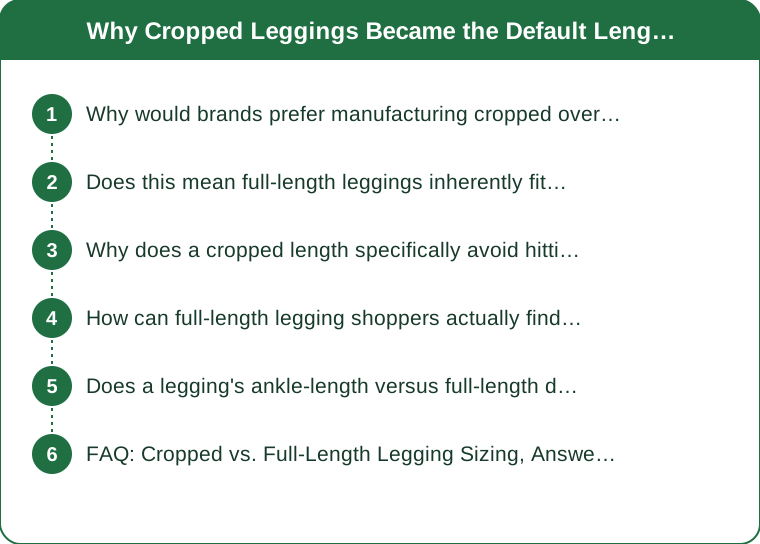
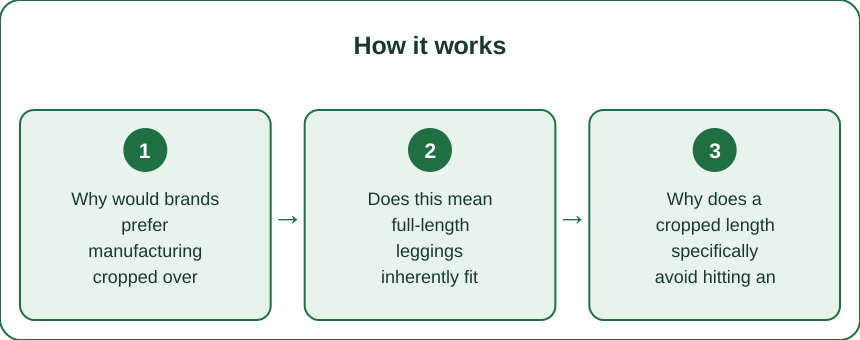
Why would brands prefer manufacturing cropped over full-length as a default?
A cropped length that ends mid-calf is more forgiving across a wider range of individual heights — falling at roughly the same relative point whether someone is 5’2” or 5’7” — while a full-length legging’s hem lands at a meaningfully different, sometimes awkward point (like the worst part of the calf) depending on individual height, increasing the chance of fit complaints and returns for a single standard length.
Does this mean full-length leggings inherently fit worse across different heights?
Only when a single standard length is offered without height-based options — brands that offer full-length leggings in multiple inseam lengths (petite, regular, tall) avoid this problem entirely, but that requires more manufacturing complexity than a single cropped length that works reasonably across more heights by default.
Why does a cropped length specifically avoid hitting an awkward point on the leg?
Cropped leggings are typically designed to end above the widest point of the calf, a length that generally reads as intentional and flattering across a wide range of body proportions — a full-length legging cut for an ‘average’ height without adjustment can inadvertently end right at that same widest calf point on someone shorter or taller than the reference height, which reads as an unflattering cut-off rather than an intentional style choice.
How can full-length legging shoppers actually find a properly fitting option?
Prioritizing brands that publish actual inseam measurements for multiple length options (not just a single ‘full-length’ label) and comparing those measurements against your own actual inseam is the most reliable method — a size chart with only one generic full-length option is more likely to produce the awkward-calf-point problem than one offering petite, regular, and tall variations.
Does a legging’s ankle-length versus full-length distinction actually matter for this problem?
Yes — true ankle-length leggings (extending to the ankle bone) sidestep the calf-cutoff problem differently than a mid-calf-ending ‘full-length’ option might, so checking the specific stated ending point relative to the ankle, not just the general ‘full-length’ label, matters for avoiding the same awkward-cutoff issue in a different spot.
FAQ: Cropped vs. Full-Length Legging Sizing, Answered
Is cropped or full-length more flattering for petite frames specifically?
It depends on individual proportions, but petite-specific full-length options (properly inseam-adjusted) generally avoid the awkward-calf-cutoff problem that a generic ‘average height’ full-length cut would create on a shorter frame.
Do all brands offering ‘tall’ sizing actually solve this cutoff problem?
Most do meaningfully improve it, though verifying the actual inseam measurement rather than trusting the tall label alone remains the more reliable approach.
Is it reasonable to hem full-length leggings that run too long?
Yes, though this works better for basic solid-color leggings than performance or compression styles, where hemming can affect the intended compression pattern near the ankle.
TL;DR:
- Cropped leggings became a retail default partly because one length fits reasonably across more heights than a single full-length option
- A generic full-length cut can land right at the least flattering part of the calf depending on individual height
- Brands offering multiple inseam lengths (not just one generic full-length label) solve this problem directly
- Checking actual inseam measurements against your own height matters more than trusting a ‘full-length’ or ‘tall’ label alone
Next full-length legging search, filter specifically for brands publishing multiple inseam options — it solves the cropped-default problem more reliably than searching by length label alone.
See It in Motion
Seen here: Super High Waist Embossed Yoga Leggings with Inner Pocket — shop it on bubblelime.com
Keep Reading
This article is for general informational and styling purposes only. Fit, sizing, and product availability may vary.
