Why the Same Legging Length Hits at a Completely Different Spot Depending on Height
Quick Answer: Legging length labels like “full-length” or “7/8” are based on a single reference height (usually 5’6”-5’7”), and since leg length doesn’t scale in perfect proportion with overall height, the identical labeled length lands at meaningfully different points on the calf depending on how far a person’s actual height and inseam sit from that reference — checking the brand’s specific inseam measurement rather than relying on the length label name is the more reliable way to predict where a legging will actually hit.
The frustration of a “full-length” legging stopping short of the ankle isn’t a fit failure — it’s a predictable consequence of length labels being built around one reference height that doesn’t represent most bodies exactly.

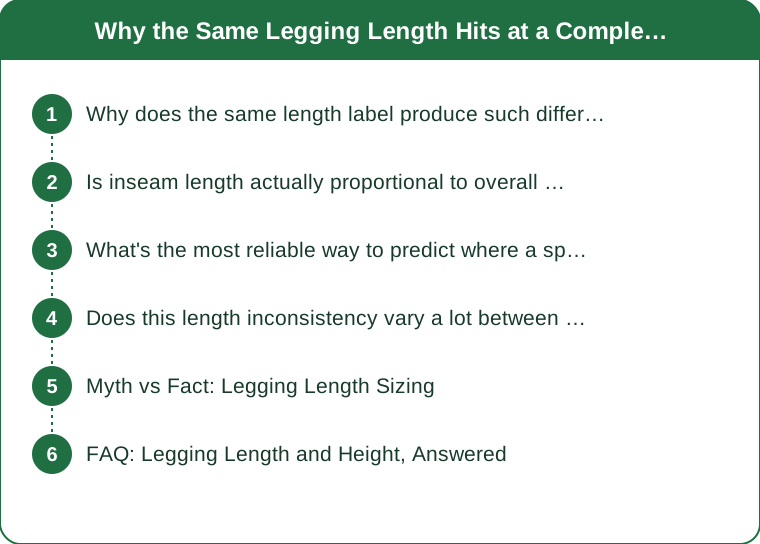
Why does the same length label produce such different actual results across heights?
Brands typically design and grade legging length based on a single reference model height, commonly somewhere around 5’6”-5’7”, and while the label (“full-length,” “7/8,” “crop”) stays consistent across sizes, the actual inseam measurement usually only adjusts modestly between petite, regular, and tall size categories — it doesn’t scale in perfect linear proportion to every possible height in between. This is why the same labeled length can be genuinely ankle-length on someone near the reference height and noticeably shorter on someone taller.
Is inseam length actually proportional to overall height, or is that assumption itself flawed?
It’s a flawed assumption for many bodies — leg length as a proportion of total height varies significantly between individuals, independent of overall height category, which means even within the same height range, two people can have meaningfully different actual inseam needs. This is part of why relying purely on a general “petite/regular/tall” category, without checking the specific inseam measurement, still leaves real room for a length mismatch.
What’s the most reliable way to predict where a specific legging will actually hit, before buying?
Checking the brand’s listed inseam measurement in inches, and comparing it against a personal inseam measurement taken from crotch to ankle, is far more reliable than trusting the length label name alone. This single number check catches mismatches that the label terminology (“full-length” meaning different things at different brands) otherwise obscures.

Does this length inconsistency vary a lot between different brands, or is it fairly standardized industry-wide?
It varies significantly — there’s no industry-standard reference height or inseam measurement behind terms like “full-length” or “7/8,” so the exact same label can correspond to noticeably different actual inseam lengths between two different brands. This is why a “full-length” legging from one brand can be a genuinely different length than a “full-length” legging from another, even in a nominally equivalent size.
Myth vs Fact: Legging Length Sizing
Myth: “Full-length” or “7/8” means the same actual inseam measurement across every brand. Fact: These terms aren’t standardized industry-wide — checking the specific inseam number for each brand is necessary to predict actual fit accurately.
Myth: Petite, regular, and tall categories fully solve the height-and-length mismatch problem. Fact: These categories help but don’t account for every individual’s actual leg-to-height proportion, which varies independent of overall height category.
FAQ: Legging Length and Height, Answered
How should someone measure their own inseam accurately at home?
Measuring from the crotch seam of a well-fitting existing pair of pants down to where they want the new legging to end, along the inside of the leg, gives a usable reference number to compare against a brand’s listed inseam.
Is it worth buying the same brand’s petite, regular, and tall versions to compare, if unsure?
For a first-time purchase from an unfamiliar brand, comparing two adjacent length categories can be a useful one-time investment to establish which category actually matches, before committing to that brand’s sizing going forward.
Do all garment types have this same length-labeling inconsistency, or is it specific to leggings?
It shows up across most bottoms with length-based labeling, though leggings’ stretch fabric makes the mismatch somewhat more forgiving in practice than a more structured pant, where the same inconsistency would be more noticeable.
TL;DR:
- Length labels like “full-length” and “7/8” are built around a single reference height, not standardized industry-wide
- Leg length doesn’t scale in perfect proportion to height, so even similar heights can need different inseams
- Checking a brand’s specific inseam measurement predicts fit more reliably than trusting the length label name
- The same label can mean different actual lengths between brands, since there’s no shared industry standard
A legging landing at an unexpected spot on the calf isn’t really a sizing mistake — it’s the predictable result of length labels never having been standardized to begin with, and checking the actual inseam number is the fix.
See It in Motion
Seen here: High Waist Yoga Leggings with Side Pockets — shop it on bubblelime.com
Keep Reading
This article is for general informational and styling purposes only. Fit, sizing, and product availability may vary.
